


Last Updated on September 25, 2026 by Domenica
Choosing between digital banking and a traditional bank comes down to how you manage your money. Digital banks (also called online banks, mobile banks, neobanks or challenger banks) run almost entirely through an app. Traditional banks pair physical branches with a full lineup of financial products and, increasingly, their own mobile apps.
This digital banks vs traditional banks guide breaks down how the two compare on fees, interest rates, branches, ATMs, investing, security, customer service and more.
Short Answer:
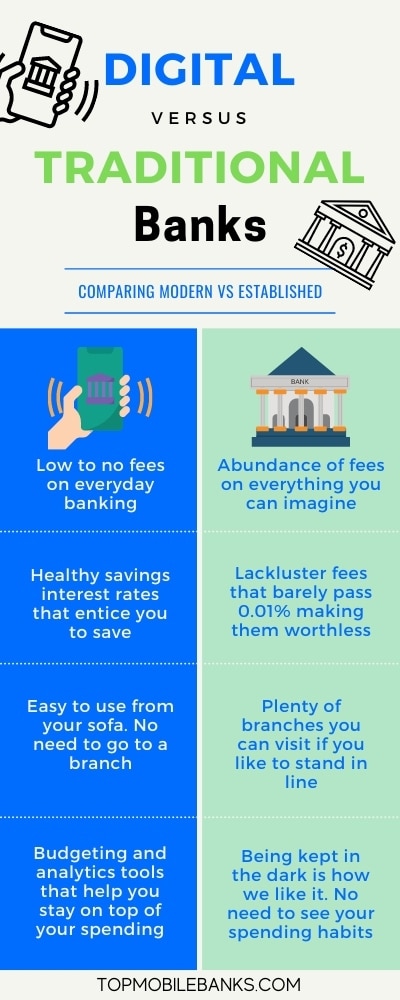
Digital banks have low to no fees, better interest rates, have better budgeting features, and are generally easier to use. On the other hand, they have no physical branches, fewer financial products, and often fewer ATMs and worse customer service.
What Is Digital Banking?
Digital banking lets you open and manage an account entirely online or through a mobile app — no branch visit required. Deposit checks with your phone’s camera, send money to friends, pay bills and track spending from one app.
Digital banks come in two main types:
- Chartered online banks hold their own banking license and FDIC insurance. Examples include Ally, Axos, SoFi and Varo.
- Fintech companies offer banking services through a partner bank that holds your money. Chime, for example, isn’t a bank itself. Its accounts are provided by partner banks such as The Bancorp Bank, N.A. and Stride Bank. N.A.
The difference matters. With a fintech, your money is typically FDIC-insured only through the partner bank, and only if that bank’s records correctly show what belongs to you. Before opening an account, check which bank actually holds your money.
What are Traditional Banks?
Traditional banks refers to banks with physical branches where you can meet with staff, deposit cash and get help in person. This includes large national banks like Chase, Bank of America and Wells Fargo, as well as regional banks, community banks and credit unions.
Traditional banks typically offer a full range of products under one roof: checking and savings accounts, credit cards, mortgages, auto and personal loans, business accounts and investment services. Nearly all now offer mobile apps with features like mobile check deposit and Zelle, so the line between “traditional” and “digital” is blurrier than it used to be. The key difference is that traditional banks still maintain physical locations and the overhead that comes with them.
Digital Banking vs. Traditional Banks
Financial products & services
There’s an impressive number of financial products and services on the market. If you’re not quite sure what they are, here’s a list of some that are available:
- Checking account
- Savings account
- Credit and debit cards
- Loans (personal, auto, business, home equity)
- Mortgages
- Cashier’s checks
- Certificates of Deposit
- Wire Transfers
- Safe Deposit Boxes
- Investing (stocks, bonds, cryptocurrency, commodities…)
- Foreign Currency Exchange
As you can see, the list is quite remarkable and far from complete. Most of the traditional big banks would have all of these available to their customers, and then some. At the same time, most digital banks refrain from offering even half of the financial services that big banks do.
Many digital banks focus on checking and savings and some go further. SoFi offers personal loans, mortgages and investing, and Chime offers a secured credit-building card. Still, few digital banks match the full product range of a large traditional bank.
Outside of United States, digital banks will more readily offer foreign exchange and money transfer services and even multi-currency accounts where you can hold up to 10 different currencies.
Some digital banks offer credit cards on top of regular debit cards to their customers. Those financial companies are certainly smart as there’s a good chunk of money to be made with ccs. The occurrence is still sporadic though.
By contrast, it would be hard to find a traditional bank that doesn’t offer or even incentivize its clients to get one or more credit cards.
Mortgages and loans of all kinds are also everyday things with traditional institutions. Not so much with online banks. There are some, such as Axos Bank, that do offer most of the financial services that big banks offer. Still, they’ve been founded more than 20 years ago and are one of the pioneers of online banking.
Launching new financial products takes time, capital and regulatory approval. Many digital banks target younger customers who mostly need a spending account, savings and easy money transfers, so a smaller product lineup often fits their audience.
Offering more financial products isn’t always the better solution. If you need more than just the essential services, you’ll have to weigh your options between traditional banks, of which most already also have mobile apps, and few digital banks that offer more.
Fees
Fees are one of the biggest differences between digital and traditional banks.
Common traditional bank fees include:
- Monthly maintenance fees: typically $5–$25, often waived with a minimum balance or direct deposit
- Overdraft fees: around $25-$35 per occurrence
- Out-of-network ATM fees
- Wire transfer fees: Averaging $20+ for domestic transfers and $25+ for international transfers
Traditional banks and credit unions made over $12 billion in overdraft and non-sufficient funds (NSF) fees in 2025, with Chase and Wells Fargo each collecting around $1 billion (National Consumer Law Center).
In 2024, Chase and Wells Fargo each collected around $1 billion in overdraft and NSF fees(Consumer Federation of
Are digital banks following suit? No, not at all. Most digital banks offer free everyday banking services. That means that there’s no monthly maintenance fee, no minimum deposits, free peer-to-peer money transfers, and free ATM withdrawals at tens of thousands of locations.
That sounds great, but how do challenger banks make money then? Well, we already established that the more savvy ones offer credit cards, which are real gravy boats for them. The rest of the pack earns good money on interchange fees.
Interchange fees are tiny amounts of money that Visa or Mastercard, for instance, charge merchants for their service when you use your card (or phone) to buy stuff. It doesn’t matter if it’s in-store or online.
They then share that small amount with the digital bank in question. A few cents per transaction may not sound like much, but at scale, the amounts add up.
They also don’t have the overhead that traditional banks and credit unions have. Think offices, branches, thousands of staff, etc. That’s how they can get away with not charging fees on most of their products.
Interest rates
Interest rates are where digital banks have the clearest edge. The national average savings rate is about 0.37% APY, according to the FDIC. Standard savings accounts at Chase, Bank of America and Wells Fargo pay closer to 0.01% to 0.04%(Investopedia).
Digital banks, by contrast, commonly pay between 3%–4% APY or more on high-yield savings(Investopedia). Without branch overhead, they can pass more of their earnings on to customers — and competitive rates help them attract deposits.
On a $10,000 balance, that’s the difference between earning about $1 a year and several hundred dollars.
Ease-of-use
This is where mobile banks really shine. The ease of use is a significant factor in stealing traditional customers to the dark side. In most cases, even for business accounts, you can download, open an account, and start using it in a matter of minutes.
The apps are straightforward and include features many traditional banks still lack, especially around budgeting and financial wellness.
Branches
Branches remain a major draw for traditional bank customers, though banks continue to close locations and replace tellers with ATMs and self-service kiosks. Most everyday tasks — deposits, transfers, bill pay — now happen online.
Still, branches matter when something goes wrong. Resolving a complex issue by phone can mean long hold times, while a branch visit puts you face to face with someone who can help. Digital banks can’t offer that option. More on customer service below.
Money Transfer
Money transfer and currency conversion, aka foreign exchange, is another gravy boat for banks – traditional and online. And, although most banks refrain from charging their customers for sending money in-house, they do charge them for money transfers to other banks and institutions.
For domestic transfers, the gap has narrowed. Most traditional banks now include Zelle in their apps for free, instant transfers to other U.S. bank accounts.
Luckily, there are digital banks that specialize in money transfers, offering them at much more reasonable rates than the competition. They’re basically money transfer services with a checking account or wallet attached to them.
Traveling
Traditional bank debit cards often charge foreign transaction fees(typically around 3% of each purchase) plus out-of-network ATM fees abroad. Some traditional banks, like Capital One, have eliminated foreign transaction fees, but they remain common.
Many digital banks waive foreign transaction fees entirely, and some let you hold multiple currencies, making it easier to avoid conversion costs.
Budgeting & analytics
Most traditional banks now offer basic spending insights in their apps, but digital banks typically go further. Many categorize every transaction automatically, show where your money goes with charts and reports, and send alerts when you’re nearing a spending limit.
You can exactly see where your money is going and where it’s coming from. Easily put limits on a category like ‘eating out’, and get a notification when you’re getting closer to the weekly amount you’re comfortable with spending.
Apart from exactly knowing where you’re bleeding money, you can also make pots, spaces, or vaults, as they’re called. They’re basically sub-accounts that you can label as you want, making categorizing and saving money much more effortless and palatable.
ATMs
Cash still matters. Cash made up about 14% of U.S. consumer payments in 2025, and four out of five consumers used cash in the previous 30 days, according to the Federal Reserve.
That’s where ATM access comes in. Traditional banks run their own ATM networks, while digital banks typically partner with networks like Allpoint or MoneyPass for fee-free withdrawals. Depositing cash is harder with a digital bank — often requiring a retail location and a fee.
Both digital and traditional banks go out of their way to emphasize the number of ATMs they own or endorse so that customers can withdraw money free of charge. Some of them are also reimbursing you for out-of-network fees if you do use a different ATM.
Investing
Traditional banks often offer investing through affiliated brokerages — Chase through J.P. Morgan, for example, and Bank of America through Merrill. This became possible after the Gramm-Leach-Bliley Act of 1999 repealed most of the Depression-era Glass-Steagall rules separating commercial and investment banking.
Fewer digital banks offer investing, but the list is growing. SoFi, Ally and Axos offer self-directed and automated investing, while apps like Cash App and MoneyLion offer stock and crypto trading. Available options vary by provider.
Security
Digital banks are often seen as less secure than traditional banks, but both face constant threats from hackers and scammers, and both have experienced breaches. Most digital banks use strong security practices like two-factor authentication and encryption.
The bigger risk with some digital banking apps isn’t hacking — it’s structure. In 2024, Synapse, a middleman connecting fintech apps to partner banks, went bankrupt, and more than 100,000 customers were locked out of about $265 million in funds. Because no bank failed, FDIC insurance didn’t apply. Before opening an account with a fintech app, confirm which FDIC-insured bank holds your money.
On the other hand, Capital One was at the focus of one of the most significant data breaches of all time when a hacker gained access to 100+ million Capital One customers’ accounts and credit card applications in 2019.
The data taken contained 106 million credit card applications and 140,000 Social Security numbers. Plus, 80,000 bank account numbers. Yeah, it’s terrible.
Security is a continued battle to protect customer information from bad players. And it isn’t a one-sided battle. As consumers, users, and clients, we have to stay vigilant as well, especially in the face of scammers.
Customer service
Customer service is a weak spot for many banks, digital and traditional alike. Chatbots and automated phone menus handle much of the first line of support, and wait times for a live person can be long.
Traditional banks have one advantage: you can walk into a branch. With a digital bank, support is limited to chat, email or phone. When something goes wrong, whether a frozen account or a fraudulent charge, fast access to a real person matters.
The Bottom Line
Traditional banks aren’t going away anytime soon. They are still extremely profitable. Much more than digital banks, in fact. That’s because even though they do have much more significant overhead in terms of branches, offices, and thousands of staff, they offer much more lucrative financial products.
Many digital banks focus on checking and savings, and that’s enough for most people’s everyday needs. For some, the best setup combines both: a traditional bank for in-person service and borrowing, and a digital bank for higher savings rates and lower fees.
More Like This
- Digital Banking is NOT the Same as Online Banking
- Fintech Vs. Digital Banking (With Examples)
- 5 Likely Outcomes for The Future of Digital Banking
- Chime Takes on Traditional Banks: Why It is Winning Over
- 8 Ways Digital Banks Make Money (Business Model)
- Cash App Vs. Bank Account (Is It a Replacement?)